
18 AUGUST 2025
Please click to download PDF
Introduction
The Commission, established within the Grand National Assembly of Türkiye (TBMM) as part of the “process” that has been on the agenda since 1 October 2024, held its first meeting on 5 August 2025. At this meeting, the Commission adopted the name “Commission on National Solidarity, Brotherhood, and Democracy” and established its 12-point working procedures and principles.
Firstly, we would like to state that we regard the establishment of such a Commission under the umbrella of the TBMM positively, as it may contribute to the resolution of fundamental issues such as ending the conflict and violence stemming from the Kurdish issue in Turkey, establishing the rule of law, democracy and social peace, and provide an opportunity to discuss the grounds on which the severely damaged social partnership can be rebuilt.
We would also like to express our belief that the Commission can be truly useful and effective to the extent that it demonstrates an unwavering commitment to addressing all these issues with reference to universal human rights values and principles.
As a human rights organisation that has been working for 35 years to promote greater respect for the concept of human rights — as a founding value — in our country and around the world, we would like to outline our views and recommendations regarding the Commission’s aims, objectives and activities below, in line with our responsibility to society.
Opinions and Recommendations
- In the relevant working procedures and principles, Article 2(1), which sets out the Commission’s purpose, states that: “The purpose of the Commission is to evaluate the work to be carried out in the areas of freedom, democracy and the rule of law with the aim of completely removing terrorism from Turkey’s agenda, strengthening social integration, and consolidating our national unity and brotherhood.”
As noted in the reports of both HRFT and other relevant human rights organisations as well as in the reports of numerous international human rights organisations, including those of the United Nations (UN) and Council of Europe bodies of which Turkey is a member, there has been an alarming decline in recent years in Turkey in terms of respect for democracy, the rule of law, and fundamental human rights and freedoms.
This finding is also reflected in major global indices that assess countries’ political regimes. For instance, the following graph, based on the Liberal Democracy Index in the 2025 Democracy Report published most recently on 12 March 2025 by the V-Dem Institute at the University of Gothenburg, shows that Turkey is going through one of the worst periods in recent history in terms of democratic values. The only worse period was during the 12 September 1980 Military Coup.
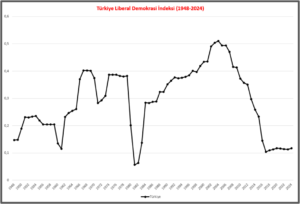
Such a serious regression in terms of democracy, the rule of law and respect for fundamental human rights and freedoms also indicates that the idea of a human rights–based regime has essentially been abandoned in Turkey, and that, instead, a state practice that systematically violates rights has become dominant. In other words, rulelessness, arbitrariness, and uncertainty have become the defining characteristics of the current regime.
Given this situation, it is even more important for the Commission to seek ways and means of implementing the principles and values of social peace, human rights and democracy. This is because the principle that fundamental rights and freedoms must be guaranteed to everyone living in Turkey without discrimination cannot be subject to any agreement or negotiation.
-
Recommendation:
At the outset of its work, the Commission should issue a declaration of intent recognizing universal human rights values and principles as fundamental norms that are not subject to negotiation and committing to uphold these values and principles as a non-negotiable basis throughout the Commission’s work. Such a declaration of intent would be the most important element in defining the genuine and essential framework for joint discussion and would also provide considerable guidance to the Commission on which issues are open to negotiation as it continues its work.
- In addition to the above, the declaration of intent will also help to clarify issues that do not require any changes to the legislation. Many of the problems currently faced would cease to exist if only the existing Constitution and laws, the international treaties to which Turkey is a party and which it has duly ratified and incorporated into its domestic law, and the decisions of the European Court of Human Rights (ECHR) whose jurisdiction it has recognized as well as those of the Constitutional Court (CC), were properly implemented. In that case, the Commission would be able to achieve its founding objectives and goals with relative ease.
-
Recommendation:
The Commission should advise the Grand National Assembly of Türkiye (TBMM), which is not only a legislative body but also has the authority to oversee the executive branch, to call upon the executive to cease its arbitrary attitudes and actions that are contrary to the current Constitution and laws, leading to erosion of institutions and uncertainty.
- Undoubtedly, the primary reason for establishing such a special Commission within the Grand National Assembly of Türkiye is the “process” that has been on the agenda since 1 October 2024. Regarding this process, the decision announced at the congress held following the calls by MHP leader Devlet Bahçeli and PKK leader Abdullah Öcalan to end the PKK’s existence, its organisational structure, and its armed struggle, followed by a symbolic event in which a group of PKK members destroyed their weapons, is of vital importance in itself. This is because every step towards ending the conflict and violence that has persisted for over 40 years, with heavy social costs in relation to the Kurdish issue, is extremely valuable, – not only because it will prevent further loss of life, but also because it will put an end to the deep anxiety and fear felt by people for the lives of their loved ones.
For this reason alone, it is of particular importance that all parties involved in this process, without exception, adopt an active stance towards ensuring the process of “laying down/destroying arms” is safeguarded, while using language that is sensitive to and considerate of the sensitivities and suffering of those directly affected by the environment of conflict and violence.
On the other hand, the cessation of conflict and violence through the laying down of arms would broaden the scope for dialogue and enhance its effectiveness, thereby enabling the resolution of the Kurdish issue through non-violent means and the establishment of a just peace.
Naturally, the primary parties to the issue of “laying down arms” are armed groups, and it is expected, indeed inevitable, that the conditions and methods of “laying down arms” will be determined primarily through discussions and negotiations between these parties.
However, numerous experiences from around the world indicate that the chances of success in “disarmament” processes increase when careful attention is paid to adhering to the “Disarmament, Demobilization and Reintegration” programmes developed by the UN based on such experiences.
-
Recommendation:
The Commission should undertake effective and concrete preparations, including the necessary legal arrangements, by adopting a participatory approach to context-specific “Disarmament, Demobilization, Reintegration” programmes, drawing on both national and international experts in the field, as also highlighted in the UN experts’ call of 11 April 2025 directly related to this process.
- It is clear that the significance of this “process,” which has been on the agenda since 1 October 2024 and is valuable in its own right, will increase to the extent that progress is made towards resolving the Kurdish issue through dialogue and negotiation, excluding violence.
The democratic and peaceful resolution of the Kurdish issue, which is extremely simple to resolve with a human-centered approach but has become complex and intricate due to historical, political, cultural and international factors, is possible through a “democratization programme” based on an approach that rejects all forms of instrumentalism and accepts democracy as a value in its own right.
Such a programme must be built, first and foremost, on the principle that the exercise and guarantee of fundamental rights and freedoms are not subject to anyone’s approval. This is because rights constitute the principles and norms that enable every citizen, without distinction, to live in a manner befitting human dignity. They are universal and inalienable.
The Kurdish issue is a political and social issue with economic, social, cultural, political and legal dimensions and, in a nutshell, refers to the guarantee of the fundamental rights and freedoms of the Kurds, primarily their identity and cultural rights. Accordingly, the parties to the peaceful democratic resolution process of the Kurdish issue are, first and foremost, the Kurds, but also all citizens living in this country.
-
Recommendation:
The Commission should develop comprehensive programmes, including legal regulations that guarantee the fundamental rights and freedoms of the Kurds, with particular emphasis on their identity and cultural rights.
- Although this process carries different connotations, the emphasis is often placed on a “shared future”. In the sense of establishing a democratic partnership with equal participation, a vision for a “shared future” must, first and foremost, be grounded in the unconditional acceptance of universal human rights principles and values.
On the other hand, for the shared envisioning of the future to be “healthy,” “the future must be able to come back,” for which “the past must remain in the past.”
However, in this country, whatever it may be called, the “past” is laden with widespread individual and social traumas caused by severe/serious human rights violations under international human rights law and international humanitarian law, occurring in a context of conflict and violence that has lasted for more than 40 years.
It is extremely difficult to forget or suppress traumatic experiences accompanied by intense emotions. Consciousness can only play the game of “ignoring/pretending not to know” in order to avoid confronting the traumatic reality, but the traumatic memory remains ever-present; in other words, “the past cannot remain in the past“. Moreover, the isolated “collective memories” formed by those exposed to mass traumas can become even more insular, distancing themselves from other identities woven around different traumas and sensitivities.
In order for “the past to remain in the past” and “the future to come back,” it is necessary to purge the effects of individual and social trauma resulting from severe human rights violations. This requires, first and foremost, the creation of an environment of trust in which those exposed to trauma will not be re-traumatised, enabling them to break free from the vortex of traumatic events and end their mental struggle with the aggressor.
In order for the requirements of these processes to be fulfilled, it is important to establish comprehensive programmes that encompass the elements of “truth-seeking”, “justice”, “reparation”, and “guarantees of non-recurrence”, as set out in the UN General Assembly resolution of 16 December 2005 on the “Basic Principles and Guidelines on the Right to a Remedy and Reparation for Victims of Gross Violations of International Human Rights Law and Serious Violations of International Humanitarian Law,” and further developed since then.
Such programmes contribute to the recognition of the rights of those who have been subjected to violations, based on the acknowledgment of norms and to the promotion of trust arising from a mutual commitment to shared norms and values, as demonstrated in particular by the work of the UN Special Rapporteur on the promotion of truth, justice, reparation and guarantees of non-recurrence, established within the UN in 2011.
These programmes are also vital for fostering social reconciliation and ensuring a just and sustainable peace.
-
Recommendation:
The Commission should take a leading role in ensuring the implementation of comprehensive programmes defined by the UN as “Transitional Justice”, which include elements such as “truth-seeking”, ” justice”, “reparation” and “guarantees of non-recurrence”, with a participatory approach centered on those affected by violations.
- In the working procedures and principles established by the Commission, Article 6(1), which regulates the quorum for meetings and decisions, provides that: “Decisions regarding the preparation of draft legislation shall be taken by a three-fifths majority of the full membership. For other matters, decisions shall be taken by a simple majority of the members present.”
As an expression of a quantitative approach to addressing certain practical issues, an “arithmetic language” is understandable to some extent.
However, what is at stake is the endeavor to build a common future based on shared values and principles, starting from a divided past. This is also an effort to rewrite “collective memory,” which entails establishing a social partnership with the other beyond traumatic memories. Therefore, if the writing of “collective memory” can proceed in parallel with truth-seeking, it can pave the way for social reconciliation. The distinctive feature of “collective memory” studies lies in the meaning and necessity of democratic debate and negotiation in the process of truth-seeking.
The precondition for democratic debate and negotiation is the principled acceptance in advance that, rather than declaring one’s position at the outset of the conversation, one must be prepared to move beyond it in order to make possible the creation of common ground at another level. This is because if the goal is a qualitative agreement rather than a mere quantitative vote count, the framework for the conversation or negotiation must be shared. The very essence of humanity’s greatest achievement, namely human rights values and principles, is the ready-made framework for any public negotiation aimed at reaching agreement.
Thus, by paying the utmost attention to public discourse and walking together step by step and with great patience, towards a shared future, it may become possible to resolve this grave issue, which is at the heart of deep suffering.
For HRFT, as a human rights organisation, it is unacceptable for a negotiation environment established with the aim of achieving social peace to be coerced into a “compromise” that bypasses persuasion processes through administrative or numerical power, given that democratic solutions cannot be found through anti-democratic methods.
-
Recommendation:
The Commission should review its decision-making procedures and reorganise them in a manner consistent with the nature of a negotiation environment established to achieve social peace, adopting a consensus-based approach grounded in persuasion not only when drafting legislation but on all matters.
Conclusion
We have expressed all of the above assessments and recommendations in the hope and with the expectation that they will contribute to a sound historical and social evaluation of the opportunity Turkey has embraced to “talk about peace”, at a time when many regions of the world, particularly the Middle East, are experiencing humanitarian crises and wars.
However, we wish to reiterate a point that we have repeatedly emphasized above and which , as a human rights organization, we consider to be of paramount importance: The Commission’s chances of success will increase to the extent that it maintains universal human rights values and principles as its primary reference while fulfilling its historical responsibility and function, that it ensures the active and effective participation of society in its work through civil actors and organizations, and that it adheres to the principles of confidentiality and transparency.
As HRFT, we would like to state that we are ready, if requested, to share all the knowledge and experience we have gained through our work in this field over the past 35 years, and to contribute in every possible way to making good use of the opportunity mentioned above.
With best regards,
HUMAN RIGHTS FOUNDATION OF TURKEY