We, a diverse group of human rights defenders ‒
reaffirming that the Universal Declaration of Human Rights remains the most important founding charter of our time;
recognizing that the institutionalization of international human rights law in accordance with the Universal Declaration and other landmark standards, such as the European Convention on Human Rights, occupies an essential and indispensable place in humanity’s quest for dignity, equality, and justice;
acknowledging that the international human rights regime depends on states and their commitment to abide by its rules and standards; that it is not designed to generate or enforce political will on its own; that it can guide and channel the exercise of political will, but cannot compensate for its absence;
noting with grave concern the erosion of the political will that have sustained the human rights mechanisms since their inception in the aftermath of World War II;
highlighting the multifaceted impact of this reality both in the domain of enforcement of international human rights standards and on the work of human rights defenders worldwide;
concerned that there are deep disparities in the extent to which individuals and groups are recognized as rights-holders and able to access and seek enforcement of the full panoply of human rights protections;
alarmed that these disparities, which are fuelled by social and economic inequalities, racism and other forms of discrimination, authoritarianism and the continuing impact of colonialism, continue to widen;
convinced that human rights solidarity and activism in their various forms serve a moral and political imperative to empower individuals and societies in all parts of the world against all forms of domination and oppression;
determined today to bring to the attention of all concerned parties (including, in particular, states, international organizations, human rights defenders and social movements) both a critical assessment of disturbing tendencies that have been evident for some time, and a call to action to respond to them.
- The international human rights mechanisms, set in motion in the aftermath of World War II to help prevent similar devastation and atrocities, have served as the foundation of international public order. However, a growing number of states consider themselves less and less bound by international human rights law and humanitarian law. At the same time, non-state actors ‒ including corporate actors and armed groups, often operating transnationally ‒ have an increasingly important influence on world affairs and the actions of states. Yet, human rights law is not sufficiently equipped to regulate the conduct of such actors effectively. Accordingly, the mechanisms for the effective protection of human rights have become worn out and, in many ways, dysfunctional.
- The erosion of the political will that has sustained the human rights regime since its inception after World War II is evident everywhere (except in official statements), particularly in enforcement. Many states avoid fulfilling their obligations under international human rights treaties, sometimes by explicitly delegitimizing their core values. Others still have more or less functioning institutions but find it difficult to maintain their commitment to promoting human rights for various reasons, including the supposedly hard facts of global realpolitik. Moreover, states with autocratic regimes or in the process of autocratization are attempting to redefine human rights in terms of allegedly traditional values that promote discrimination against women and LGBTI+ persons and systematically undermine their rights. At the same time, they are shrinking civic space and harassing civil society actors who promote respect for human rights.
- The imposition of double standards by powerful global actors inevitably provokes skepticism about the human rights system among the world’s diverse peoples. The reason is not difficult to understand: in many instances of armed conflict, the international community has failed to take a principled stance against indiscriminate military attacks against civilians in flagrant violation of both international human rights law and international humanitarian law. Entire populations are deprived of fundamental rights and threatened in their existence while certain militaries are unstoppable, and the whole world watches, as we are witnessing in Palestine. More generally, statements and policies that bear the stamp of “the West and the rest” undermine the universalism of the human rights discourse, thereby leading to the public perception ‒ especially in situations where human rights advocacy is most needed ‒ that such a discourse is yet another mask of colonialism and imperialism.
- The profound inequalities systematically produced by the current economic and social order continue to undermine human rights as a global benchmark of justice in general, and social justice in particular. As social and economic rights are marginalized within mainstream human rights discourse, working people no longer couch their demands primarily in “universal rights” language and associate a human rights discourse that ignores social and economic inequalities with an elite endeavour. In this context, it is worth noting that the discursive appeals of certain leaders and parties, which have been described as “populist” or “proto-fascist”, have alarmingly gained significant traction with millions of people in our societies.
- All these worrying circumstances (i) signal the risk of a disconnect between various pressing demands and a human rights regime that, while effective at the time, now seems too slow, formalistic, bureaucratic and ineffective to tackle the rights crises experienced by some of the most marginalized individuals and groups around the world; (ii) undermine the work of human rights defenders in various ways and pose a serious obstacle to local organizations seeking to access international human rights mechanisms or to have their voices heard by an international audience; (iii) limit the space for dialogue between civil society and political authorities, resulting in a policy-making process largely insulated from the influence of human rights defenders and social movements; (iv) ultimately lead to the trivialization of these universal standards and the mechanisms that support their application and enforcement, with deleterious effects both for the principle of multilateralism and the effective protection of democracy, human rights and the rule of law at national and international level.
These are serious problems, and like all such problems, they will remain unaddressed unless they are identified in and through public discussion, and acknowledged by the international human rights mechanisms and the institutions that oversee their application and enforcement.
Noting that human rights defenders have raised similar concerns in different parts of the world;
reaffirming that the creation of a comprehensive human rights space over time has been a very significant achievement, which has empowered millions of people around the world in the past and continues to empower them today; and
recognizing that any serious attempt to address the problems above must build on this achievement, we emphasize the following as an urgent duty for human rights defenders all over the world:
- persistently articulating and substantiating the significant problems caused by the failure of states to fulfil their obligations under customary international law, international treaties, and national constitutions;
- openly and uncompromisingly rejecting “exceptionalism” in all its forms, wherever it comes from, as it undermines the universality of human rights both in itself and in the eyes of the public;
- taking a clear stance against the marginalization of social and economic rights, as well as collective rights, and reclaiming their indispensability to the universal promise of human rights discourse, especially today when unprecedented inequalities threaten our societies.
We urge the international human rights community, including international and regional human rights mechanisms and courts and the community of states that have signed and ratified human rights treaties, to advocate for the urgent need for a renewed commitment to the necessity of ensuring the effectiveness of international human rights mechanisms, and to recognize the widespread frustration on the ground, as this signals a significant risk ‒ the risk of trivialization and marginalization ‒ to the entire human rights regime.
We firmly believe that today ‒ when so many of the world’s 8.5 billion people live in deep poverty and deprivation as a result of violent conflicts and inequalities of all kinds, and when ecological destruction and climate change pose an unprecedented threat to the very existence of life ‒ it is necessary to regenerate the constitutive role of human rights as the core operating lens through which to ground humanity’s sustainable coexistence on the earth.
We note that “state power”, notwithstanding its singular importance in the enforcement and implementation of human rights norms, is not identical with “political power” per se and that political power ‒ at least democratically understood ‒ is anchored in processes of opinion and will formation that take place in the public sphere, including social movements and civil society at large. With this in mind, we advocate an embedded, multilateral and bottom-up approach that affirms the constitutive role of human rights.
We commit ourselves and call upon all concerned human rights actors, social movements (including environmental and climate change movements), and international organizations:
- to demonstrate the vitality of the human rights discourse and to foster recommitment to multilateralism through broad alliances that embody cooperation across diversities;
- to promote effective collaboration with both grassroots defenders and international organizations, and to support their cooperation and dialogue to advance the practical implementation of human rights in a positive direction;
- to confront, challenge and disrupt colonial infrastructures and their continuing legacies that distort the diversity of human rights space, and undermine the panoply of safeguards provided by human rights mechanisms;
- to expand the human rights space with new claim-making practices advanced by justice-oriented social movements and to make human rights law resonate more concretely with claims for local and global justice on the ground;
- to support legislation and positive due diligence practices that encourage businesses to respect human rights throughout their sphere of influence, and to hold multinational corporations accountable when they violate human rights, including social and economic rights.
A human rights violation in one place is a human rights violation everywhere!
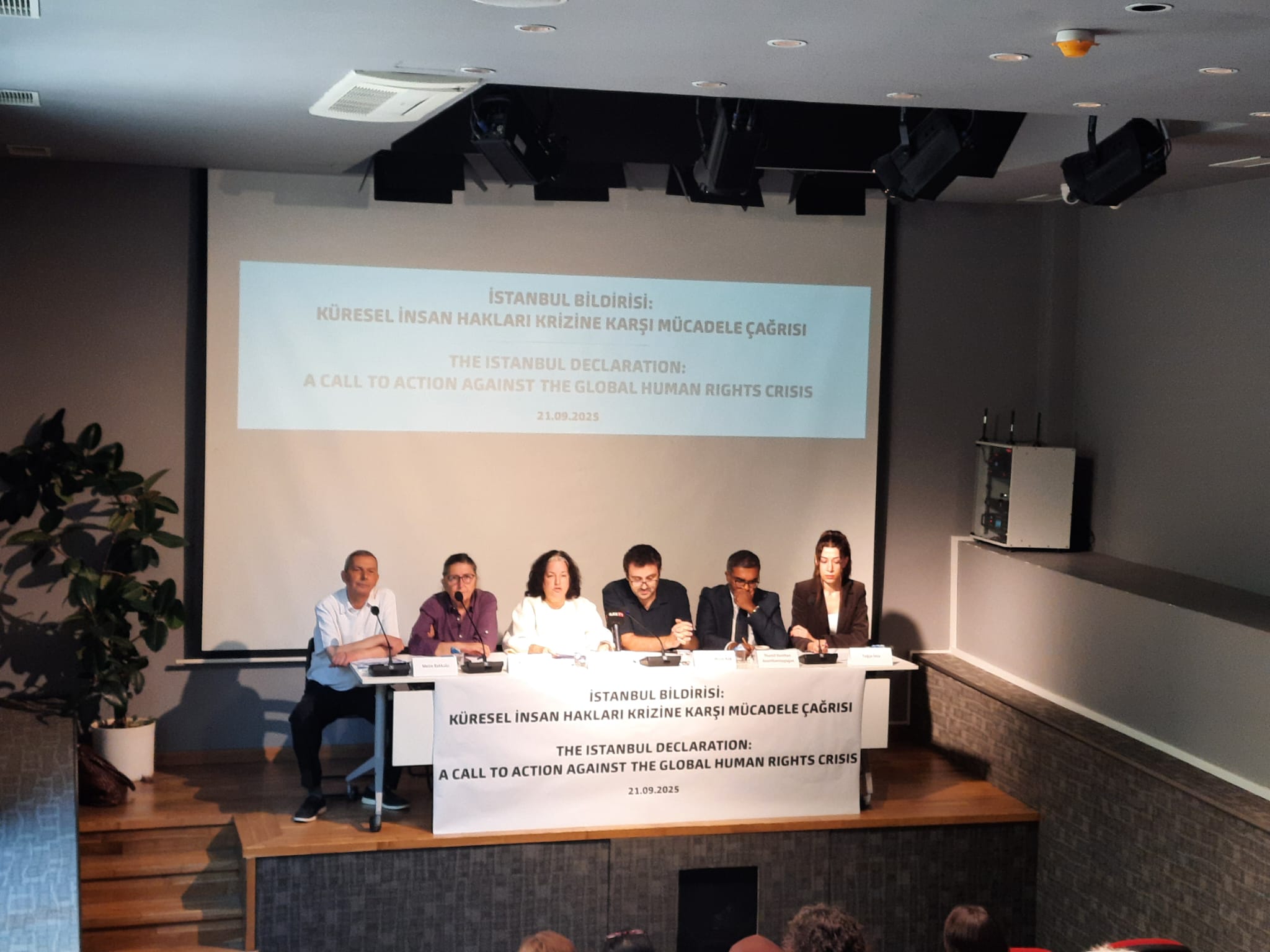
This statement reaffirms the values of embedded and principled universalism, solidarity, diversity, and tolerance. It is endorsed by a diverse group of human rights defenders, who convened in Istanbul, Turkey, on May 18-19, 2024. The signatories, listed alphabetically below, endorse the statement as individual human rights defenders independent of their organizational and/or professional affiliations.
21 September 2025, İstanbul
Signatories
- Andrés Gautier-Hirsch, PhD, El Instituto de Terapia e Investigación sobre las secuelas de la tortura y la violencia Estatal – ITEI
- Beate Ekeløve-Slydal, Political Scientist and Human Rights Defender
- Carla Ferstman, Director of the Human Rights Centre of University of Essex
- Coşkun Üsterci, Secretary General of the Human Rights Foundation of Turkey – HRFT
- Eren Keskin, Co-Chairperson of the Human Rights Association – İHD
- Ezel Buse Sönmezocak, Human Rights Lawyer
- Gunnar M. Ekeløve-Slydal, Human Rights Defender
- Ioulietta Bisiouli, Director of the European Implementation Network – EIN
- Lutz Oette, Professor of Law, Co-director of SOAS Centre for Human Rights Law
- Metin Bakkalcı, Chairperson of Human Rights Foundation of Turkey – HRFT
- Mümtaz Murat Kök, Human Rights Foundation of Turkey – HRFT
- Nilgün Toker, Human Rights Foundation of Turkey – HRFT
- Olga Sadovskaya, Vice-Chair of Crew Against Torture, human rights defender
- Samah Jabr, Consultant Psychiatrist – Palestine
- Sebla Arcan, Human Rights Association – İHD
- Serdar Tekin, Human Rights Foundation of Turkey – HRFT
- Thamil Venthan Ananthavinayagan, Adjunct Lecturer at Maynooth University, Ireland and Adjunct Professor Woxsen University, India
- Tuğçe İnce, Human Rights Foundation of Turkey – HRFT
- Turgut Tarhanlı, Academic
- Victor Madrigal Borloz, Eleanor Roosevelt Senior Visiting Researcher, Human Rights Program, Harvard Law School
- Yasmine Louanchi, International Federation for Human Rights – FIDH
- Yüksel Genç, The Center for Socio Political Field Research